

Why the 500 m³/h Airflow Tier Demands a Different Sourcing Strategy
The 500 m³/h airflow range occupies a distinct position in the ventilation market: large enough to serve multi-unit residential buildings, small offices, and retail spaces, yet compact enough that installation constraints and occupant proximity introduce criteria that bulk industrial selection can overlook. An energy recovery ventilation system at this scale often sits in ceiling voids or mechanical closets adjacent to occupied zones, making noise performance and service access equally as critical as heat exchange efficiency. The manufacturer you choose must demonstrate competency across both performance metrics and practical installation engineering.
Core Performance Metrics That Define a Quality Recuperator at Mid-Range Airflow
Heat exchange efficiency remains the primary benchmark — a capable recuperator at 500 m³/h should achieve 70–85% enthalpy recovery under rated conditions, backed by independent laboratory test data rather than catalog claims. Equally important is the static pressure capability of the integrated fans; insufficient fan performance leads to under-ventilation once duct resistance is factored in. A manufacturer worth engaging will provide full fan curves showing airflow versus external static pressure, not a single operating point. For a heat recovery ventilation system installed in noise-sensitive environments, published sound power data at the target airflow becomes non-negotiable — below 40 dB(A) at 1 meter is a reasonable expectation for quality mid-range units.
Certifications, Factory Depth, and the Real Cost of Corner-Cutting
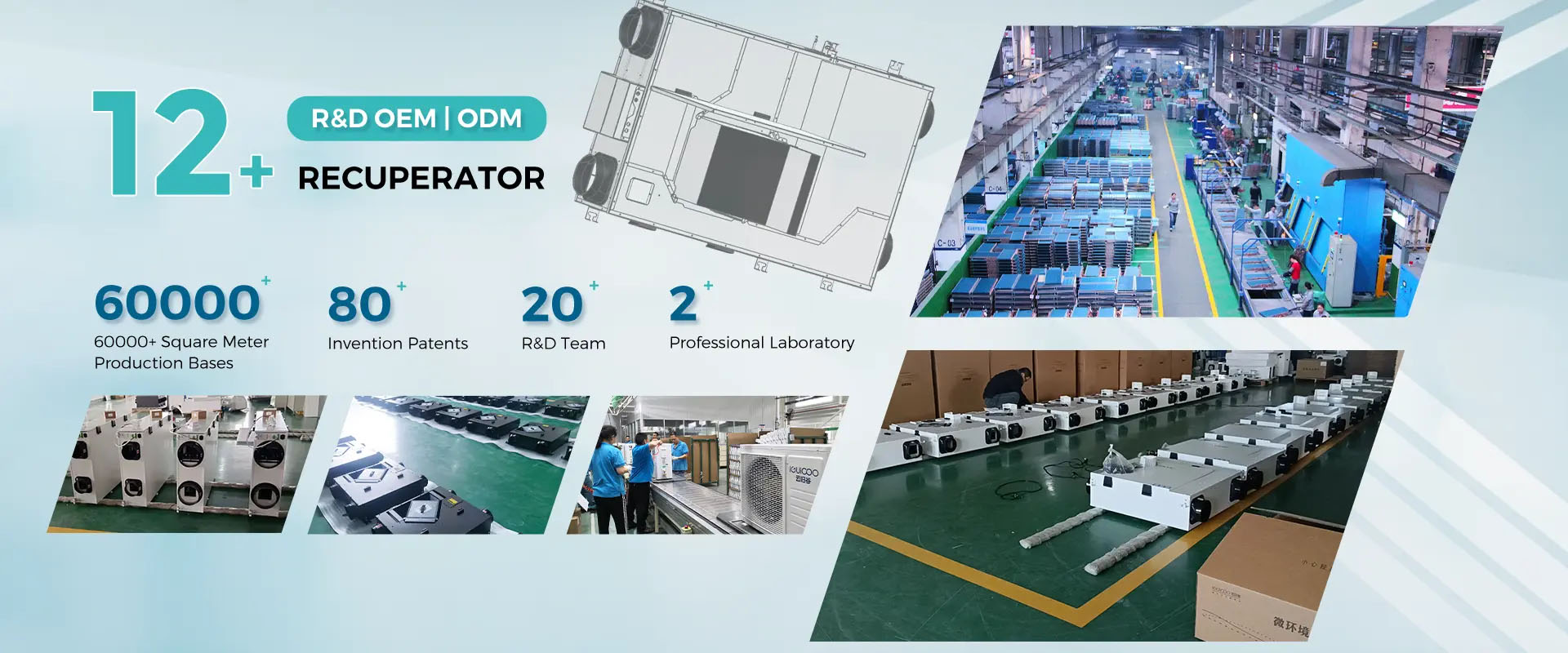
CE marking and ISO 9001 establish baseline legitimacy, but deeper signals separate strategic suppliers from transactional sellers. In-house enthalpy core production indicates control over the most performance-critical component. A minimum 8–10 years of continuous operation in the HVAC sector correlates with refined production processes and supply chain stability. The recuperator market includes manufacturers who rely on low-cost, low-efficiency paper-based cores — these degrade within 2–3 years under sustained humidity cycling. Specify the core material type in your RFQ and require a minimum warranty covering core performance, not just motor and electronics. IGUICOO’s ceiling-mounted ERV series for mid-range airflow applications delivers factory-validated enthalpy recovery with compact dimensions engineered for tight mechanical spaces. Where climate extremes demand additional conditioning, IGUICOO’s ERV with preheating and precooling function provides staged thermal treatment without increasing the unit footprint.
Post time: Jul-28-2026


