

Verifying the Manufacturer Behind a Home HRV or Energy Recovery Ventilation System
The real question is not whether Chinese catalogues list a home HRV system, but whether the factory holds tolerance across a production run — the point a contractor or project buyer needs answered. In cold, dry housing stock a heat recovery ventilator usually beats an energy recovery ventilation system on sensible recovery, because latent transfer earns its premium in humid air. Process evidence matters as much for an energy recovery ventilation system as for a home HRV platform.
Frost Control and Cold-Climate Trade-Offs
In cold climates, frost control is the first failure point for a home HRV system and an energy recovery ventilation system alike. Ask how the heat recovery ventilator defrosts — recirculation damper, preheater or core bypass — at what temperature, and whether that logic is documented. Suppliers selling an energy recovery ventilation system on latent recovery alone tend to under-specify the HRV fresh air path. Then ask for the sensible curve behind the heat recovery ventilation efficiency figure, separately from the number offered for their energy recovery ventilation system.
Process Capability: Core Craft, Airflow and Sound
“High-quality” only becomes checkable against process data, and so does any best HRV system claim. Core plate spacing, membrane thickness and glue lines decide whether rated airflow survives into production units, so ask for a sample-to-production comparison: dimensional report, leakage test and airflow-versus-static-pressure curve from a batch, not a golden sample. Traceability for an energy recovery ventilation system, or for an energy recovery ventilation (ERV) system on the same line, is a fair proxy: factories documenting one platform usually document the other. Sound deserves equal scrutiny: a small HRV system often sits close to sleeping areas. Anyone comparing HRV systems for homes should demand sound data at installation static pressure.
Evidence You Can Audit: Batch Records, Warranty and Compliance
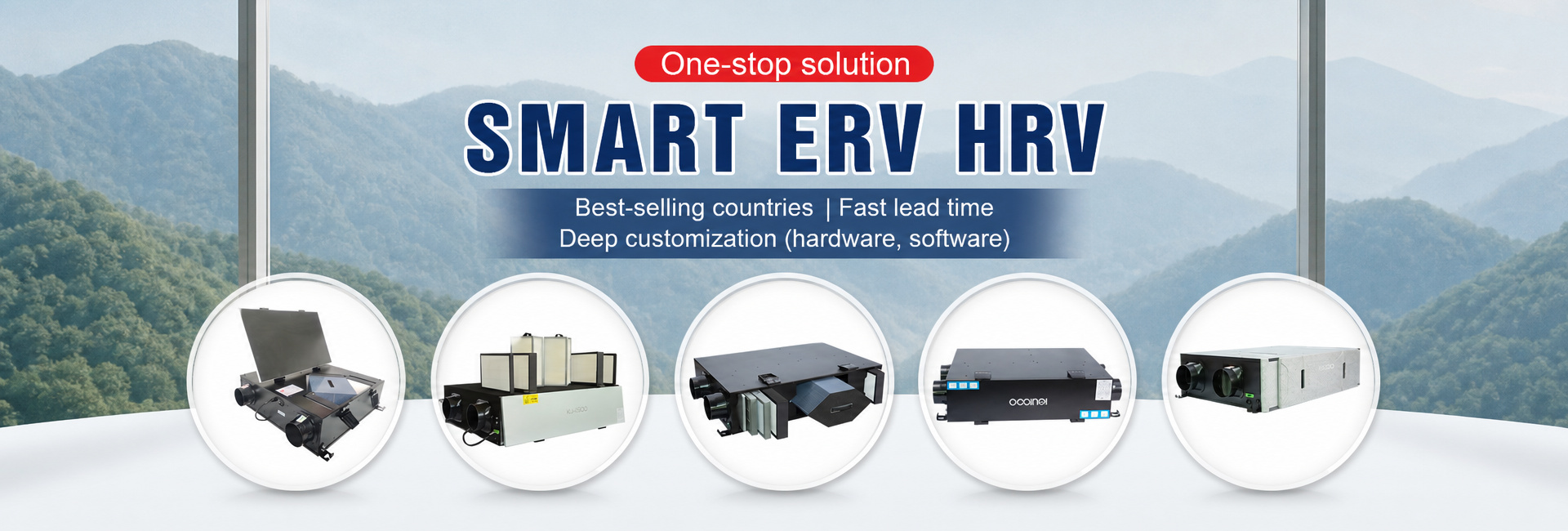
Finally, test the paperwork. A verifiable China HRV manufacturer should provide batch sampling records, warranty terms and spare-part availability for its residential heat recovery ventilator range, plus CE and ErP documentation for the same fan-power expectations that a household energy recovery ventilation system faces. In an HRV system in house renovation, a wall mounted heat recovery ventilator avoids new duct runs, and an HRV home ventilation system should share the spares chain of a whole house HRV system. Then test after-sales directly: a factory quoting repair lead times for an energy recovery ventilation system can equally answer for an HRV.
High-quality China HRV manufacturers do exist, but quality is documented, not national — an energy recovery ventilation system is no different. IGUICOO has manufactured heat recovery and fresh air system products since 2013, holds more than 80 patents plus ISO 9001, ISO 14001, ISO 45001 and CE certification, and builds its home HRV series around batch test records. Ask every candidate — factory-direct wholesaler, OEM ODM partner or distributor — the same three questions. When a supplier produces compliant records for an energy recovery ventilation system as readily as for a home heat recovery ventilation system or a residential energy recovery ventilator, the claim becomes testable.
Contact IGUICOO for a customized ERV solution tailored to your project requirements.
Post time: Sep-22-2026


