

What Global Buyers Should Evaluate in a China Fresh Air Units Supplier
For contractors, distributors and project buyers specifying residential ventilation, the decision is rarely driven by marketing copy. It comes down to whether a manufacturer can hold certified performance across a full order, document it clearly, and scale supply to a multi-unit residential programme without eroding build quality. Certification alone does not answer that question; manufacturing discipline does. Supplier selection therefore becomes an engineering assessment as much as a commercial one.
Engineering Depth and Verified Heat Recovery Ventilation Efficiency
Any credible energy recovery ventilation system starts with a tested core rather than a datasheet claim. Heat recovery ventilation efficiency should be evidenced by third-party test reports, and the sensible and latent performance of an energy recovery ventilator must be separated from that of an HRV, because the two behave differently in hot-humid and cold-dry climates. Buyers should also confirm that the ventilation strategy follows recognised guidance such as ASHRAE Standard 62.1 for residential and mixed-use projects. Management-system certifications such as ISO 9001, ISO 14001, ISO 45001 and CE indicate process discipline rather than a performance level, but they remain a reliable filter when shortlisting overseas manufacturers.
A Residential Range That Fits Real Installation Constraints
A single platform cannot serve every dwelling. Wall mounted heat recovery ventilator units suit retrofit apartments with limited ceiling voids, while a ceiling mounted heat recovery unit is often the practical choice for new-build properties with accessible service space. For larger dwellings, comparing HRV systems for homes against ERV systems for homes is a climate decision first: in humid summers the ERV core’s moisture transfer supports indoor humidity control, while a whole house HRV system suits drier, colder regions where latent load is minimal. Distributors gain real leverage when one partner can supply a whole house ERV system for larger properties and a compact home ERV system for apartments from the same component base, keeping spares and installation logic consistent across a portfolio.
Factory-Direct Supply, OEM/ODM and Project Support
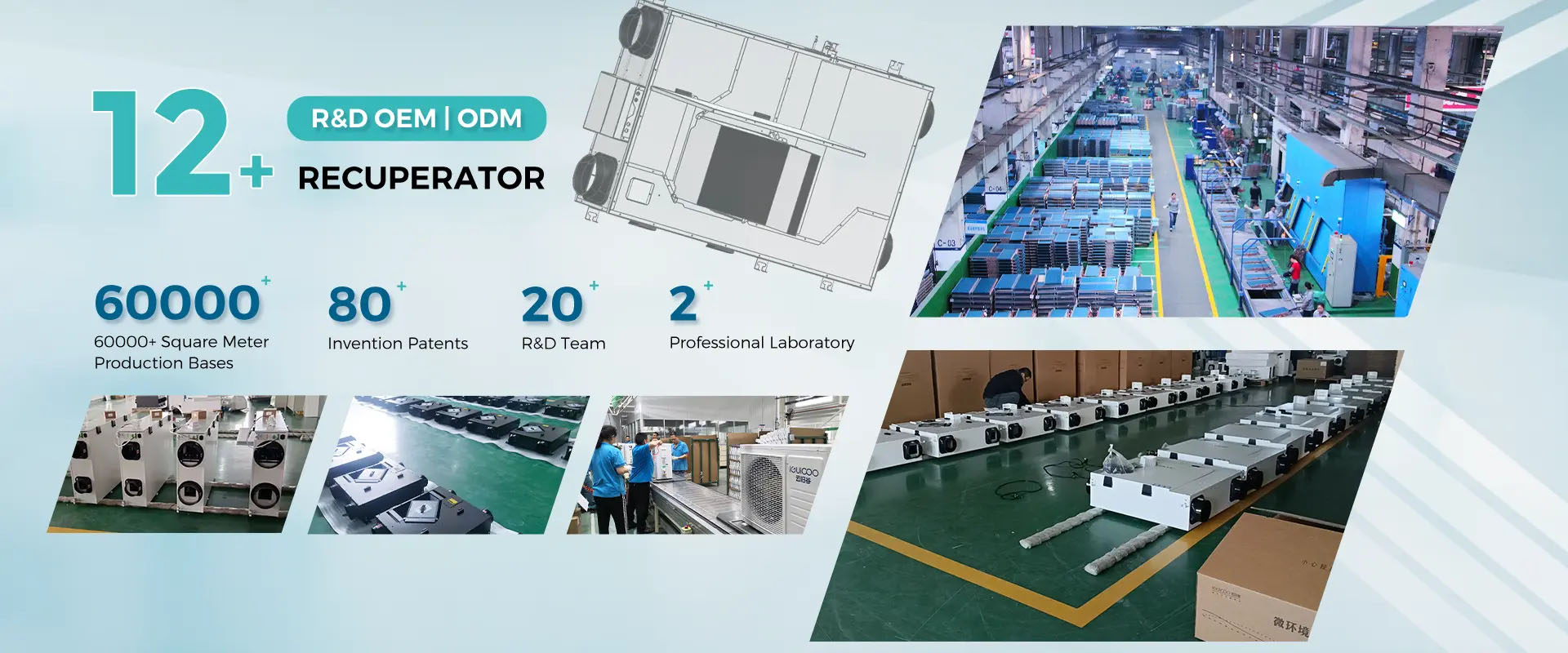
For wholesale programmes, the commercial model matters as much as the hardware. Factory-direct supply shortens the chain between production and site, and OEM ODM capability lets distributors launch a home heat recovery ventilation system range, or a residential energy recovery ventilator line, under their own brand without rebuilding tooling or re-certifying from scratch. Practical support — drawing review, static pressure selection, installation guidance and aftersales parts — often decides whether a project completes on schedule, and lead-time reliability is what secures the second order. A responsive factory partner reduces site delays, protects your margin on installation labour, and keeps the specification consistent when a project is delivered in phases.
IGUICOO has manufactured heat recovery ventilation systems since 2013, holds more than 80 patents, and supplies a ceiling-mounted ERV series for residential and light commercial projects. For buyers evaluating fresh air system suppliers in China, the practical test is straightforward: request test reports, request references from your own climate zone, and request a documented lead time before committing volume. Those three answers separate a trading intermediary from a manufacturer able to carry a residential programme from first sample to repeat order.
Contact IGUICOO for a customized ERV solution tailored to your project requirements.
Post time: Sep-17-2026


